


Winning in Small Claims and Getting Paid Aren't the Same Thing
A tenant moves out owing three months of rent. A customer never pays a $6,000 invoice. You've been patient, you've sent the reminders, and you're done waiting. Small claims court feels like the obvious next step: file, show the judge your paperwork, win.
And you might win. But a judgment is a piece of paper that says someone owes you money. It isn't the money. In Texas, the space between those two things can be long, expensive, and sometimes impossible to close.
Before you spend the filing fee and the time, here's what that space actually looks like.
What a judgment does (and doesn't) do in Texas
Texas justice courts hear small claims up to $20,000, and you don't need a lawyer to file. That part is genuinely accessible. Collecting is where it gets harder.
When you win, the court doesn't collect for you. If the other side doesn't pay voluntarily, it's on you to take the next steps, and Texas law limits what those steps can reach:
Only non-exempt property can be taken. Texas protects a lot from creditors, including a person's homestead and many personal items. If someone has little that isn't protected, a writ of execution may come back with nothing.
Wages generally can't be garnished for an ordinary debt like back rent or an unpaid invoice. A bank account garnishment is possible, but it's a separate legal process with its own paperwork and fees.
There's a wait before you can act. The other side has time to appeal, and an appeal can restart the case in county court.
None of this means a judgment is worthless. It means winning is the start of a second project, not the end of the first one.
The real cost of filing and collecting
The filing fee is the number most people look at. It's the smallest part of the bill. Fees vary by county, but here's the kind of math to run before you file:
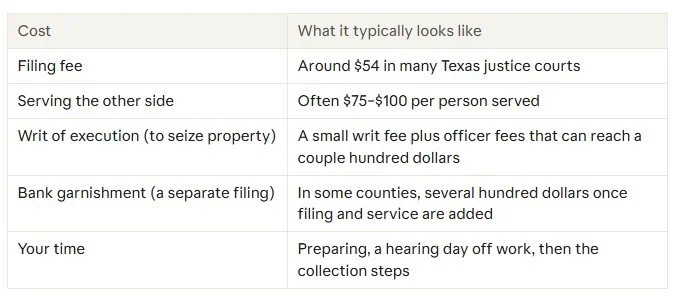
You can ask the court to add your costs to the judgment. But that only helps if the judgment itself gets paid. If it doesn't, those costs are money you spent chasing money you never received.
That's the trap: the longer you chase, the more you've invested, and the harder it feels to walk away.
The middle step: one conversation before you file
There's an option between "keep waiting" and "file a lawsuit": mediation. You and the other side sit down (online, from wherever you are) with a neutral mediator and work out what happens next.
Why that can matter when getting paid is the goal:
You can build in how payment actually happens. A payment plan, a partial amount now, a deadline that works for both sides. A judge's order says what's owed. A mediated agreement can also spell out how and when.
Both sides shape the agreement. People tend to take an agreement more seriously when they had a say in it, rather than having one handed to them.
It's often done in a few hours. No waiting for a court date, no day off for a hearing.
Court is still there. If you can't reach an agreement, you haven't given up your right to file.
It isn't a guarantee. Mediation only works if both sides are willing to talk, and no one can promise a result. But it costs far less to find out in one conversation than to learn it after a judgment.
What it typically costs: $250 an hour, split evenly between both sides. A typical case takes 4–6 hours, which usually comes to about $750–$1,000 per side, including a $250 deposit per party to reserve the session.
Before you file, talk it through
If you're owed back rent, an unpaid invoice, or money from a deal that went sideways, a free consultation is a low-risk way to see whether mediation fits your situation. No commitment, and no pressure to choose it.
I'm Nikkita Torres with Neutral Voice Mediation. I mediate small business and landlord–tenant disputes online across Texas.
This post is general information, not legal advice. Court fees and procedures vary by county and can change; check with your local justice court or an attorney about your specific situation.