

Neighbor Dispute Mediation
You cannot choose your neighbors. But you can choose how you resolve the conflict — and mediation is almost always the better option.
Neighbor disputes are some of the most uniquely stressful conflicts a person can face. Unlike a dispute with a stranger or a business you cannot simply walk away and never see them again. They live next door. You share a fence, a wall, a street, or a community. The conflict follows you home every single day.
And because of that the stakes feel personal in a way that other conflicts do not. It is not just about the property line or the noise or the tree branches — it is about feeling safe and comfortable in your own home.
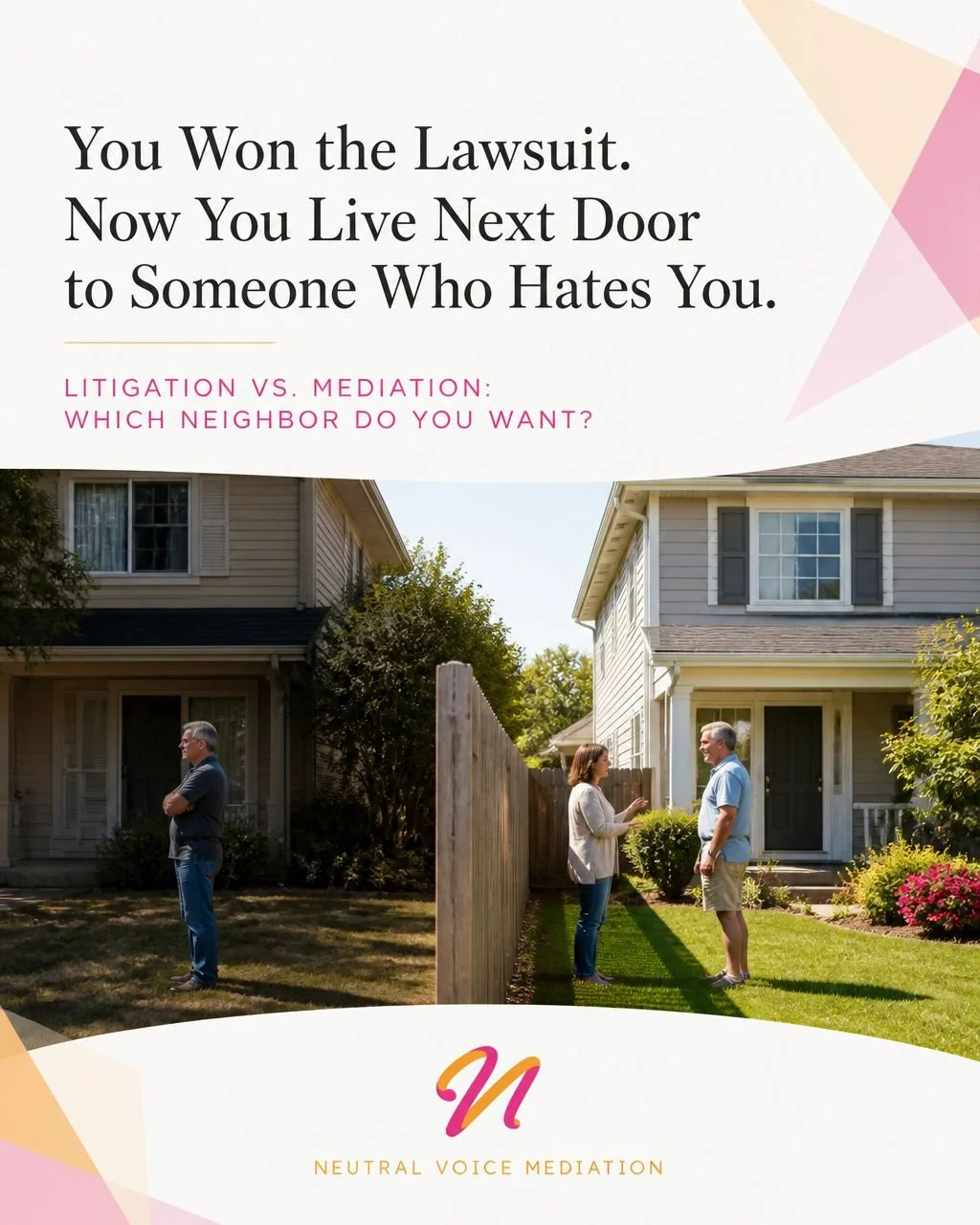
Going to court over a neighbor dispute is rarely the answer. It is expensive, slow, unpredictable, and it almost always makes the relationship worse. Even if you win in court you still have to come home to the same neighbor afterward.
Mediation is different. It resolves the dispute privately and constructively — addressing the actual issue and creating an agreement both neighbors can live with — literally.
I am Nikkita, a certified mediator at Neutral Voice Mediation. I work with neighbors, HOA members, and community residents virtually across Texas and the United States to resolve disputes quickly, confidentially, and without the cost and stress of litigation.
Common Neighbor Disputes I Help Resolve
-
Disagreements about where one property ends and another begins are among the most common neighbor conflicts. Whether the issue involves a fence, a structure, a driveway, or landscaping mediation provides a neutral space to review the facts and reach an agreement both parties can commit to.
-
Loud music, late night gatherings, barking dogs, construction noise — noise disputes escalate quickly and can make home feel like anything but a sanctuary. Mediation helps both neighbors reach clear and reasonable agreements about noise levels, hours, and expectations going forward.
-
Overhanging branches, invasive roots, blocked sunlight, and falling debris are surprisingly common sources of neighbor conflict. Mediation helps both parties reach a fair resolution without the cost of legal action.
-
Questions about who is responsible for maintaining a shared fence, who pays for repairs, and what the fence should look like are common points of contention. Mediation resolves these disputes with clear agreements about responsibility and cost sharing.
-
Blocked driveways, parking in front of someone else's home, and disputes over shared parking spaces can create ongoing tension. Mediation establishes clear expectations and agreements that both neighbors understand and accept.
-
Dogs that bark, animals that enter neighboring properties, and disagreements about pet behavior are among the most emotionally charged neighbor conflicts. Mediation creates space for both parties to express their concerns and reach workable solutions.
-
Conflicts between homeowners and their HOA or between neighbors within a shared community — over rules, fines, shared amenities, or community decisions — can be resolved through mediation without the formality and expense of a legal proceeding.
-
In rural communities disputes about livestock that cross property lines, noise and odor from agricultural operations, and damage caused by animals are common. Mediation provides a practical and private way to resolve these conflicts between neighbors who often have longstanding community ties worth preserving.
Why Mediation Is Better Than Court for Neighbor Disputes
Taking a neighbor dispute to court creates winners and losers — and then sends both of you back to the same street. Here is what mediation offers instead:
-
![]()
You stay in control of the outcome
In court a judge decides. In mediation both neighbors create the solution together. That means the agreement reflects what actually works for your specific situation rather than a generic ruling.
-
![]()
It is private
Court proceedings are public record. Mediation is completely confidential. Nothing discussed in the session can be used against either party in a legal proceeding.
-
![]()
It is faster
Neighbor disputes that go to court can take months to resolve. Mediation typically resolves in one or two sessions.
-
![]()
It is more affordable
No filing fees, no attorney costs, no time away from work sitting in a courtroom. Mediation is a fraction of the cost of litigation.
-
![]()
It preserves the relationship
You still have to live next to this person. Mediation gives both neighbors the opportunity to reach a resolution without permanently destroying the relationship — which makes for a more peaceful home and a healthier community.

A Note for Rural Communities — Farmers and Ranchers
Neighbor disputes in rural communities often involve unique issues that urban mediation does not always account for — livestock crossing property lines, agricultural noise and odor, water and drainage disputes, access road conflicts, and damage caused by animals or equipment.
These disputes are often between people who have known each other for years and who share more than just a property line — they share a community. That makes resolution both more important and more delicate.
Mediation respects those community ties. It resolves the issue without the adversarial dynamic of litigation and without the public nature of a court proceeding — protecting both the relationship and the reputation of everyone involved.
If you are in a rural community in Texas navigating a neighbor or agricultural dispute I would love to help. All sessions are virtual so distance is never a barrier.
What Neighbor Dispute Mediation Looks Like
-
We start with a no-pressure conversation where you share what is happening and I answer your questions about the process. No commitment required.
-
Each neighbor meets with me privately before the joint session. This gives each party a confidential space to share their full perspective, their concerns, and what they most want the resolution to look like.
-
Both neighbors come together with me facilitating. We work through the dispute systematically — hearing each party's perspective, identifying the core issues, and working toward an agreement that both neighbors can genuinely accept.
-
The terms you reach are documented in a mediation agreement that both parties review and sign. This agreement is enforceable and can be submitted to the appropriate authority if needed.
Frequently Asked Questions
Yes — private mediation is voluntary and both parties need to be willing to participate. If your neighbor is hesitant about the process reach out and I can help you think through how to approach that conversation in a way that is more likely to get a yes.
Do both neighbors have to agree to mediation?
1
Yes. The agreement both parties reach is documented and signed by both neighbors making it legally enforceable. Having a written agreement also prevents future disputes about what was agreed upon.
Is the mediation agreement legally binding?
2
HOA disputes can be more complex depending on the specific rules and governing documents of your community. Mediation can still be very effective in these situations — both for disputes between individual homeowners and the HOA and for disputes between neighbors within the community. Reach out and we can talk through your specific situation.
What if the dispute involves HOA rules?
3
What if my neighbor has caused property damage?
4
Mediation can address compensation for property damage as part of the overall resolution. Both parties can present their documentation and reach an agreement about responsibility and payment in the mediation session.
Yes. Mediation is completely private and confidential. Nothing discussed in the session can be used against either party in a legal proceeding. Both neighbors can speak honestly about the situation without fear that it will come back to hurt them.